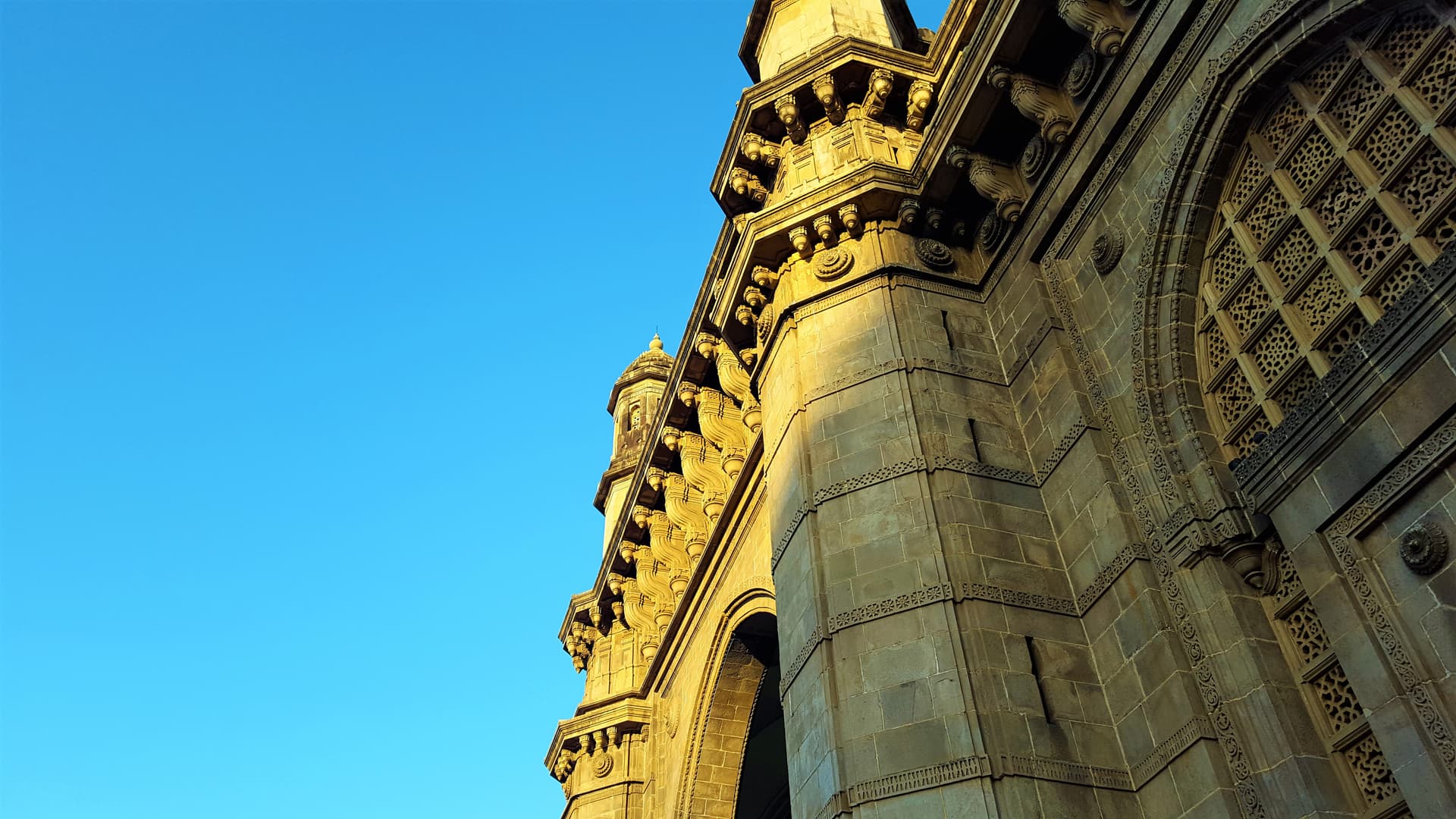
Gateway of India
다른 이름: Mumbai's Front Door · गेटवे
Mumbai, Maharashtra · monument
Mumbai's 26-metre basalt arch on the Arabian Sea — by day a busy boat jetty for Elephanta, by sunset the city's most romantic open-air gathering spot.
소개
The Gateway of India is Mumbai's most instantly recognizable landmark and one of India's most visited monuments. Built between 1911 and 1924, this 26-meter tall arch was constructed to commemorate the visit of King George V and Queen Mary to India in 1911, though it came to symbolize India's independence movement and eventual freedom from British rule. The monument features a magnificent Indo-Islamic architectural style, with yellow basalt and limestone in horizontal stripes creating a striking visual impact. Four turrets with domed tops flank the main arch, and intricate carvings and stone details showcase excellent craftsmanship.
The Gateway of India stands on the waterfront in Colaba, one of Mumbai's most vibrant neighbourhoods, directly overlooking the Arabian Sea. The monument serves as a symbolic gateway to India for arriving visitors and has historically been the point where dignitaries first arrived by sea. Today, it remains the starting point for boats to Elephanta Island, making it both a monument and a functional transportation hub. The surrounding esplanade is perpetually bustling with visitors, local families, street performers, photographers, and vendors.
For vegetarian travelers, the Gateway area offers exceptional dining and street food experiences. The Colaba Causeway district, adjacent to the monument, is famous throughout India for its vegetarian food scene. Numerous restaurants, cafés, juice stands, and street food vendors cater to vegetarian preferences without any dietary compromise. The monument itself welcomes visitors of all faiths and backgrounds in a secular, inclusive atmosphere.
The best time to visit the Gateway of India is late afternoon through evening (3:00 PM to sunset), when the weather is cooler and the light is most photogenic. Sunset views over the Arabian Sea create spectacular photographic opportunities, with the yellow and white stone glowing in warm orange and pink tones. The cooler evening breeze off the sea provides relief from Mumbai's typical heat and humidity. Weekday visits are less crowded than weekends, though the monument remains lively at all times.
The adjacent Colaba Causeway is legendary in Mumbai food culture. Vegetarian visitors can sample everything from fresh fruit juices and lassi to vada pav (spiced potato fritter), pani puri (crispy wafers with tamarind water), bhelpuri (savory puffed rice salad), and an infinite variety of sweet treats. Famous restaurants within walking distance offer delightful vegetarian fare. The promenade around the monument is perfect for evening walks and people-watching.
Practical information: the Gateway of India is free to visit and accessible 24 hours, though security presence is significant at the entrance. Photography is permitted freely. The monument sits on the Arabian Sea waterfront, and the salt air and humidity mean any photography gear should be protected. Plan 30–45 minutes to explore the monument itself, then allocate time for exploring Colaba Causeway's shops and eateries. The boat ticket office for Elephanta Island is adjacent to the Gateway, making it easy to combine this visit with an island trip.
여행 계획
관람 시간
- • Open 24 hours — monument plaza is always accessible
- • Boat ticket counters: 9:00 AM to 5:30 PM
- • Last Elephanta ferry departs 3:30 PM (return by 5:30 PM)
입장료: Free entry to the monument plaza (open 24 hours). Elephanta ferry: ₹220 round trip (lower deck) / ₹260 (upper deck). Elephanta Caves entry separate: ₹40 Indian / ₹600 foreigner.
교통 안내
🚇 가까운 지하철: Chhatrapati Shivaji Maharaj Terminus (CSMT, Central Railway) — 2.5 km. Mumbai Metro currently does not reach Colaba; nearest metro station is Cuffe Parade (Aqua Line, opening 2025).
🚶 지하철에서 도보: From CSMT main exit, walk south down DN Road and Shahid Bhagat Singh Road for 25 minutes (2.5 km). Easier: take a taxi for ₹150 or BEST bus #103.
주차
street · ₹50–₹100 (paid street parking)
No dedicated visitor parking. Limited paid street parking on Apollo Bunder Road; usually full by 5 PM. Strongly recommend Uber, Ola, taxi, or BEST bus.
🚕 택시 팁: Uber and Ola drop directly at the Gateway entry barrier on Apollo Bunder Road. Black-and-yellow Mumbai taxis from CSMT cost ₹120–₹180 (metered). Cool Cab (AC) adds 25%. BEST bus #1, #3, #103 stop at Regal Cinema (400 m walk).
가는 방법: The Gateway of India is in Colaba, South Mumbai. From Mumbai Central Railway Station, take taxi or BMTC bus (30 minutes). From Chhatrapati Shivaji Maharaj Terminus, taxi or bus (20 minutes). From Mumbai Airport, taxi (45 minutes to 1 hour). BEST buses and local trains serve the area from across Mumbai.
가족 및 접근성
가족 추천 포인트
- • Wide flat plaza ideal for strollers and wheelchairs
- • Pigeon-feeding and balloon vendors entertain young children
- • Elephanta ferry is a memorable 1-hour boat ride for kids (life jackets provided)
- • Public washrooms across the road (paid, ₹5–₹10) — basic but functional
문화 예절
권장 사항
- Visit at sunset for the warmest light on the basalt and the cooling sea breeze
- Combine with Elephanta Caves for a full day — buy ferry tickets at the kiosk by 9 AM
- Walk Colaba Causeway after dark — Mumbai's best vegetarian street food strip is 5 minutes away
- Carry a refillable water bottle — Mumbai humidity is intense even in winter
- Use Uber or Ola — Colaba street parking is impossible
금지 사항
- Do not buy "tickets" from anyone outside the official ferry kiosk — ferry to Elephanta is the only thing that needs a ticket and it is sold by the MTDC counter only
- Do not bring food or large bags into the security cordon — they will be checked
- Do not engage with photographers offering "instant prints" — heavy upselling, low quality
- Do not feed the pigeons — local authorities are phasing this out for hygiene reasons
- Do not swim or wade — the harbour water is heavily polluted and currents are strong
👕 복장: No formal dress code. Light, breathable cotton clothing recommended given Mumbai humidity.
📷 촬영 규정: Personal photography is free and unrestricted. Tripods and professional shoots require permission from the local police station. Drones are prohibited (the area is a restricted naval zone — Indian Navy western command is adjacent).
사기 주의
The "Free Photo" Phone Grab
A friendly local offers to take a family photo with your phone, then demands ₹500–₹2,000 once the photo is taken — refusing to return the phone until paid.
공식 조언: Never hand your phone to anyone you don't know. Ask another tourist (other foreign travellers are safest) or use the timer.
Inflated Boat Tickets
Touts on the plaza approach with "private boat to Elephanta" or "VIP ferry tickets" at 3–5× the official price.
공식 조언: The only legitimate ferry tickets are sold at the MTDC counter on the jetty (₹220 lower deck, ₹260 upper deck round trip). Pay only there.
Henna and "Friendship Bracelet" Touch
A vendor takes your wrist and starts applying henna or tying a "free friendship bracelet," then demands ₹500+ to "complete" the work.
공식 조언: Keep your hands at your sides and walk away firmly the moment you're approached. Do not engage.
맛집 탐방
Bademiya (veg counter)
0.4 kmVeg seekh roll and paneer tikka — Tulloch Road institution since 1946; the veg menu is separate from the meat side
Theobroma Colaba
0.6 kmBrownies, fresh chocolate truffles, and croissants — Mumbai's favourite veg-friendly café chain
Kailash Parbat (Sindhi Colony)
0.5 kmRagda pattice, dal pakwan, and kulfi falooda — pure-veg Sindhi institution since 1952
Café Mondegar
0.8 kmVeg cheese omelette, paneer mushroom toast, and fresh lime soda — the iconic Mario Miranda murals are a Mumbai must-see
Trishna (veg menu)
0.7 kmVeg Hyderabadi biryani — Mumbai's most awarded restaurant; book ahead
주변 관광지
Taj Mahal Palace Hotel
0.05 kmThe 1903 Indo-Saracenic icon directly opposite the Gateway — heritage tours daily at 11:30 AM and 3:30 PM (book online).
Colaba Causeway
0.5 kmMumbai's most famous street-shopping and street-food strip — 1 km of stalls, cafés, and boutiques.
Elephanta Caves
11 kmUNESCO-listed 5th-century rock-cut Hindu temple-caves on Elephanta Island — 1-hour ferry from the Gateway jetty.
Chhatrapati Shivaji Maharaj Vastu Sangrahalaya (Prince of Wales Museum)
0.8 kmMumbai's flagship museum — Indo-Saracenic gem with exceptional miniature paintings, sculpture, and Indus Valley artefacts.
Marine Drive
3 kmThe "Queen's Necklace" — 3 km arc of Art Deco buildings along the Arabian Sea; spectacular at night.
화장실 및 위생
프로 팁: The public toilets across Apollo Bunder Road (₹5–₹10) are 🔴 basic. For premium-clean, walk into the Taj Mahal Palace Hotel lobby (next door) — the lobby restrooms are spotless and accessible without a room key. Theobroma and Café Mondegar washrooms are also reliable for café customers.
결제 및 통신
🏧 가까운 ATM: HDFC and ICICI ATMs on Colaba Causeway (300 m). SBI ATM at Regal Cinema (400 m).
📡 공공 와이파이: Free MumbaiWiFi available at the plaza (limited; SMS-OTP login required). All major Indian SIMs (Jio, Airtel, Vi) work flawlessly.
🔌 충전소: No public charging points. Cafés on Colaba Causeway (Theobroma, Mondegar, Starbucks) all have plug points for customers.
촬영 및 드론
💰 장비 요금: Free for personal phones and handheld cameras. Tripods, gimbals, and professional shoots require police permission. Drones strictly prohibited (restricted naval area).
📍 최고의 촬영 장소: The classic frontal shot from the centre of the plaza at sunset, with the Taj Hotel just visible to the right. For a less-photographed angle, walk to the Radio Club rooftop bar (book ahead) or shoot from the Elephanta ferry as it departs.
🌅 최고의 조명 시간: 5:30 PM – 6:45 PM in winter for warm amber sandstone tones; sunrise (6:00–7:00 AM) for an empty plaza
쇼핑 및 기념품
✓ 추천 구매
- • Handicrafts and silver jewellery from Colaba Causeway stalls (bargain hard)
- • Books and second-hand classics from the pavement booksellers on Causeway
- • Fab India and Anokhi for ethical block-printed cotton (3 minutes walk)
✗ 피해야 할 것
- • "Antique" coins, "ivory" carvings, and "Mughal" miniatures from touts — none are genuine
- • "Pashmina" shawls hawked on the plaza — almost always synthetic
- • Henna application from street vendors — see scam alerts
흥정: 있음
긴급 및 건강
긴급 전화
👮 관광 경찰: Colaba Police Station, Shahid Bhagat Singh Road (300 m from the Gateway, multilingual staff, 24×7)
🎒 분실물: Report at Colaba Police Station, Shahid Bhagat Singh Road. Lost passports also need a report at the Regional Passport Office, Worli.
💊 가까운 약국: Wellness Forever (Colaba Causeway) and Apollo Pharmacy (Cusrow Baug) — both 24×7, within 500 m.
대기질: Mumbai AQI is "Moderate" most of the year, "Poor" in November–January. Sea-side air at the Gateway itself is markedly cleaner than inland Mumbai.
식수 안전: Drink only sealed bottled water. Tap water in Colaba is municipally treated but not safe for tourists.
현지인 팁
🌅 숨은 명소: For the iconic "Gateway with the Taj Hotel" symmetric shot, position yourself on the south end of the plaza near the statue of Shivaji Maharaj at sunset — the angle puts both monuments in a single frame.
🎯 혼잡 회피 팁: Visit between 6:30 AM and 8:00 AM — the plaza is almost empty, the light is soft, and the morning fishermen and joggers create wonderful atmospheric photos.
💎 재미있는 사실: The Gateway was originally built as a temporary cardboard structure for the 1911 royal visit; the actual stone monument took 13 more years to complete and was inaugurated in 1924 — by which point King George had been dead 12 years and the British Empire was in decline.
⚡ 빠른 투어
45 minutes — arrive by Uber, walk the plaza, photograph the arch and Taj Hotel, grab a Theobroma brownie on the way out.
🔭 심층 투어
Full day — 9 AM Elephanta ferry, 1 PM lunch at Kailash Parbat, 3 PM Prince of Wales Museum, 5:30 PM sunset at Gateway, 7 PM dinner on Colaba Causeway, 9 PM walk Marine Drive.
연혁
역사
The Gateway of India was conceived to commemorate the December 1911 visit of King George V and Queen Mary to India — the first visit by a reigning British monarch. Because the actual stone monument could not be ready in time, a temporary cardboard arch was erected for the royal landing at Apollo Bunder. The foundation stone for the permanent structure was laid in March 1913, but design revisions, funding shortfalls, and the First World War delayed construction. The monument was finally inaugurated by Viceroy Lord Reading on 4 December 1924. In a historical irony, the Gateway became the symbolic exit point of British rule rather than its triumphal entry: on 28 February 1948, the last British troops to leave independent India — the First Battalion of the Somerset Light Infantry — marched through the Gateway to board ships for England, marking the formal end of nearly 200 years of British colonial presence in India.
🏛️ 건축가: Designed by the Scottish architect George Wittet, then Consulting Architect to the Government of Bombay, in the Indo-Saracenic style. Wittet fused 16th-century Gujarati and Mughal motifs (the central arch echoes Fatehpur Sikri's Buland Darwaza) with the Roman triumphal-arch tradition. The monument is built of yellow basalt and reinforced concrete, faced in honey-coloured Kharodi stone, and stands 26 metres (85 feet) tall.
의의
The Gateway of India is Mumbai's most internationally recognisable landmark and a Grade I heritage structure under the Maharashtra Ancient Monuments and Archaeological Sites and Remains Act. Beyond its architectural pre-eminence as the finest Indo-Saracenic civic monument in India, it carries unique dual symbolism — built to celebrate British imperial power but witnessing the formal exit of British rule 24 years later. It remains the ceremonial entry point for visiting heads of state arriving by sea, the departure jetty for the UNESCO-listed Elephanta Caves, and Mumbai's most enduringly photographed urban set-piece.
카테고리
태그