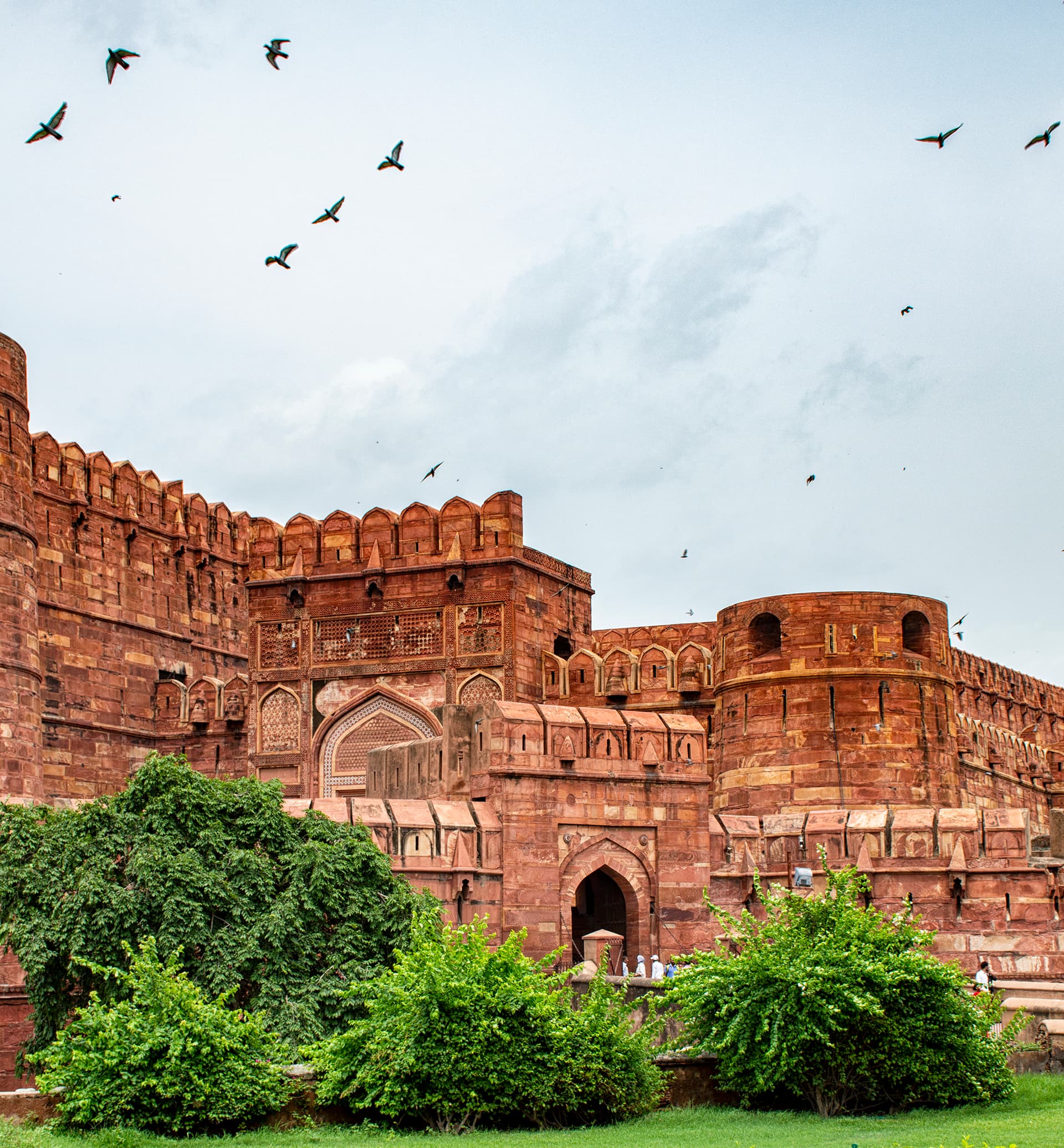
Agra Fort
別名: Lal Qila Agra · आगरा का लाल किला
Agra, Uttar Pradesh · fort
Akbar's 16th-century red sandstone fortress-city — the seat of Mughal power for three generations and the site of Shah Jahan's gilded imprisonment.
Featured Outlets
The Local Flavor Pillar
Panchi Petha
Heritage InstitutionSince 1955 — Agra's most trusted petha institution
Agra's most trusted petha institution since 1955 — the definitive source for original, kesar, anguri, and pan petha varieties.
Original Plain Petha · ₹100
Avg. for two: ₹300 · ★★★★★
Bhikharam Chandmal
Heritage InstitutionSince the 1880s — Agra's dalmoth institution
One of Agra's oldest sweet and namkeen shops — the undisputed champion of dalmoth, Agra's signature crunchy spiced lentil snack.
Original Agra Dalmoth · ₹200
Avg. for two: ₹400 · ★★★★★
Ram Babu Paratha Bhandar
Street FoodOld City Legend — Agra's definitive Mughlai paratha
Agra's most beloved Mughlai paratha counter — thick ghee-fried stuffed flatbreads served with dal makhani in the old city.
Alu Mughlai Paratha · ₹80
Avg. for two: ₹250 · ★★★★
概要
Agra Fort is the mightiest Mughal fortification in northern India and one of Agra's three UNESCO World Heritage Sites alongside the Taj Mahal and Fatehpur Sikri. Construction began under Emperor Akbar in 1565 on the site of an older Lodi fort; successive emperors Jahangir and Shah Jahan added palaces of increasing opulence, creating a compound that chronicles the full arc of Mughal imperial taste — from Akbar's robust red sandstone work to Shah Jahan's delicate white marble inlaid with lapis lazuli and cornelian.
The 94-acre enclosure contains some of the finest Mughal architecture outside the Taj Mahal. Diwan-i-Am (Hall of Public Audience) is where the emperor received petitions from an elaborately carved white marble throne. Diwan-i-Khas (Hall of Private Audience) features columns of exceptional carved refinement. Khas Mahal are Shah Jahan's private apartments. Jahangiri Mahal is a palace built in the Hindu style for Akbar's Rajput queens. Most poignant of all is Musamman Burj — the octagonal marble tower from whose balcony the imprisoned Shah Jahan, deposed by his son Aurangzeb in 1658, gazed toward the Taj Mahal and the tomb of Mumtaz Mahal until his death in 1666.
For vegetarian travellers the fort area is well served. Kinari Bazaar, a five-minute walk from the Amar Singh Gate, is lined with petha shops and traditional namkeen stalls — Panchi Petha and Bhikharam Chandmal both have counters nearby. Agra Fort Railway Station sits directly adjacent to the complex, making it ideal as a first stop on an Agra day-trip: arrive from Delhi's Hazrat Nizamuddin on the Gatimaan Express, spend three hours at the fort, then continue to the Taj for sunset. Official ASI-licensed guides at the entrance (₹500–700 for two hours) add enormous historical depth to the visit.
旅行プラン
見学時間
- • 6:00 AM to 6:00 PM (gates close at sunset)
- • Last entry 5:00 PM
入場料: Foreigners ₹650, Indian nationals ₹50. Children under 15 free. Composite ticket with Taj Mahal saves ₹50 if visited the same day. Tickets online at asi.payumoney.com.
アクセスガイド
🚇 最寄り駅: Agra Fort Metro Station (Agra Metro Yellow Line, opened 2024) — 600 m walk to the Amar Singh Gate
🚶 駅からの徒歩: From Agra Fort Metro Station, walk south 600 m along the marked pedestrian route to the Amar Singh Gate. Path is flat and signposted.
駐車場
on-site · ₹50–₹100
Designated parking lot opposite the Amar Singh Gate; gets full by 10 AM on weekends. Battery rickshaws (₹20/person) shuttle from the parking lot to the gate.
🚕 タクシーのコツ: Uber and Ola drop directly at the Amar Singh Gate parking. Auto-rickshaw from Agra Cantt Station is ₹80–120 (15 min); from Taj Mahal South Gate ₹60–80 (10 min).
アクセス: Agra Fort Railway Station is directly adjacent — the easiest approach. From Agra Cantonment Station, take auto-rickshaw (₹80–120, 15 minutes). From Taj Mahal South Gate, it is a 2 km ride (₹60–80 by auto). Prepaid taxi from Agra Cantonment costs ₹150–200.
家族とバリアフリー
家族向けの見どころ
- • Vast open courtyards safe for children to walk
- • Wheelchairs available at the gate (deposit ID); steep ramps in the upper palaces are challenging
- • Audio guide in English and Hindi (₹118) — kids enjoy the Shah Jahan imprisonment story
- • Indian-style washrooms at the entrance; cleaner facilities at nearby hotels
文化的マナー
すべきこと
- Arrive at 6:00 AM opening — golden hour light on red sandstone is spectacular and the fort is empty
- Hire an ASI-licensed guide (₹500–700 for 2 hours) — the palaces make little sense without context
- Carry a refillable water bottle — there are no reliable refill stations inside
- Wear closed-toe walking shoes — the cobbled ramps are uneven and slippery in the rain
- Combine with the Taj Mahal as a same-day visit — the composite ticket saves ₹50
避けること
- Do not bring food, large bags, drones, or tripods — they will be confiscated at security
- Do not climb on the parapet walls or carve graffiti — fines are enforced and there are CCTV cameras
- Do not engage with unauthorised guides outside the gate — only ASI photo-ID guides are legitimate
- Do not skip Musamman Burj — it is the most historically significant spot in the entire fort
- Do not visit on Friday — the fort is closed and the wasted trip is a common mistake
👕 服装: No formal dress code, but modest dress is recommended. Comfortable walking clothes and closed shoes are practical for the long ramps and courtyards.
📷 撮影ルール: Personal phones and DSLRs are free to use throughout. Tripods, gimbals, and professional shoots require a ₹2,500/day ASI permit. Drones are strictly prohibited.
詐欺注意
The Fake "Government Guide"
A man in a vaguely official-looking shirt approaches at the gate, claims to be a "government guide," quotes ₹500, then demands ₹2,000+ at the end with hard-sell tactics.
公式アドバイス: Real ASI guides wear a photo ID badge and are listed at the ticket counter. Always agree on price in writing and pay only at the end.
The "Closed Today" Auto Diversion
Auto-rickshaw drivers near Agra Cantt Station claim Agra Fort is "closed today" and offer to take you to a marble emporium instead, where they earn commission.
公式アドバイス: Agra Fort is closed only on Fridays. Verify on asi.nic.in and insist on the Amar Singh Gate. Use Uber/Ola if the auto driver refuses.
グルメ案内
Panchi Petha (Kinari Bazaar)
0.5 kmOriginal kesar petha and dalmoth — Agra's most trusted 150-year-old sweet shop
Bhikharam Chandmal
0.5 kmSohan halwa and traditional namkeen — Kinari Bazaar institution
Ram Babu Paratha Bhandar
1.5 kmGhee paratha with dal makhani and aloo sabzi — old-city legend
Mama Chicken Mama Franky House (veg counter)
1.2 kmVeg franky and paneer rolls (the veg counter is separate from the meat side)
近くの観光地
Taj Mahal
2.5 kmShah Jahan's marble masterpiece — visible from Musamman Burj inside the fort.
Jama Masjid (Agra)
0.4 km17th-century red-sandstone Mughal mosque built by Jahanara Begum, opposite the fort's Delhi Gate.
Itmad-ud-Daulah ("Baby Taj")
4.5 km1628 marble jewel-box tomb — the architectural rehearsal for the Taj Mahal.
Mehtab Bagh
4 kmThe "Moonlight Garden" across the Yamuna — canonical sunset view of the Taj.
トイレと衛生
プロのコツ: Cleanest washrooms are at the entrance complex near the ticket counter — 🟡 average. There are no facilities inside the fort itself, so use them before entering.
支払いと通信
🏧 最寄りATM: SBI ATM at Agra Fort Railway Station (300 m); HDFC and ICICI ATMs in Kinari Bazaar (500 m).
📡 公共Wi-Fi: No public Wi-Fi inside the fort. Jio and Airtel both work well.
🔌 充電スポット: No public charging points. Bring a power bank (under 10000 mAh — larger banks are confiscated at security).
撮影とドローン
💰 機材使用料: Free for personal phones and handheld cameras. Tripods, gimbals, and professional shoots require a ₹2,500/day ASI permit.
📍 ベスト撮影スポット: The view of the Taj Mahal from Musamman Burj at sunrise — Shah Jahan's last view, framed by the marble jali screens.
🌅 光の良い時間: 6:00 AM – 7:30 AM for golden light on the red sandstone; 4:30 PM – 5:30 PM for warm afternoon tones
お土産と買い物
✓ おすすめ品
- • Sealed boxes of Panchi Petha and Bhikharam Chandmal sweets from Kinari Bazaar
- • Marble inlay coasters from government-certified workshops (verify the GI tag)
- • Leather goods from Sadar Bazaar (Agra is the leather capital of North India)
✗ 避けるべき品
- • Marble miniatures from gate-side touts — almost always plaster, not marble
- • "Antique" Mughal coins — none are genuine
- • Pashmina shawls hawked outside the gate
値段交渉: あり
緊急と健康
緊急連絡先
- Pan-India Emergency112
- Tourist Helpline (24×7, multilingual)1363
- Agra Tourist Police+91-562-242-1204
- Women's Helpline1091
👮 観光警察: Tourist Police booth at Amar Singh Gate — multilingual staff, 24×7
🎒 落とし物: Report at the Tourist Police booth at Amar Singh Gate. Lost passports also need a report at Agra City Police Station, MG Road (3 km).
💊 最寄り薬局: Apollo Pharmacy on MG Road (2 km, open till 11:00 PM); 24×7 chemist at SR Hospital (3 km).
大気汚染: Agra's AQI is "Poor to Very Poor" from late October to early February. Carry an N95 mask if asthmatic.
水の安全: Drink only sealed bottled water. There are no refill stations inside the fort — carry your own.
通の小ワザ
🌅 隠れた絶景: Walk to the upper terrace of Khas Mahal at 5 PM — the Yamuna and Taj Mahal align in the distance and most tour groups have already left.
🎯 混雑回避のコツ: Tour buses from Delhi arrive 9:00–10:00 AM. Visit at 6:00 AM opening or after 4:00 PM to have the palaces nearly to yourself.
💎 豆知識: Only about 25% of the fort complex is open to the public — the remaining 75% is still under Indian Army occupation as a strategic cantonment, just as it was under the British and the Mughals.
⚡ 短時間ツアー
90 minutes — Amar Singh Gate, Diwan-i-Am, Diwan-i-Khas, Musamman Burj, exit. Skip Jahangiri Mahal.
🔭 じっくりツアー
Half day — 6 AM Agra Fort opening, 9 AM breakfast at Ram Babu Paratha Bhandar, then continue to Itmad-ud-Daulah and Mehtab Bagh for sunset.
歴史
歴史
Agra Fort was constructed by Emperor Akbar between 1565 and 1573 on the site of an earlier Lodi-era fort he had captured. Akbar relocated the Mughal capital from Delhi to Agra and built the fort as both military stronghold and imperial residence. His grandson Shah Jahan transformed much of the interior in the mid-17th century, demolishing several of Akbar's red sandstone palaces to build the white marble Khas Mahal, Diwan-i-Khas, and Musamman Burj for himself and Mumtaz Mahal. After Shah Jahan was deposed by his son Aurangzeb in 1658, he was imprisoned in the fort's Musamman Burj for the last eight years of his life, gazing across the Yamuna at the Taj Mahal he had built for Mumtaz. The fort later passed to the Marathas, the Jats, and finally the British East India Company in 1803, who used it as a military base and continue to occupy three-quarters of its area as an Indian Army cantonment to this day.
🏛️ 設計者: Akbar's court architects directed the original 1565–73 red sandstone construction in a robust Indo-Islamic style, while Shah Jahan's additions a century later — Khas Mahal, Diwan-i-Khas, and the Musamman Burj — were executed in white marble with pietra dura inlay by the same workshops then building the Taj Mahal nearby.
意義
Designated a UNESCO World Heritage Site in 1983, Agra Fort is one of the finest examples of Mughal military and palace architecture and chronicles in stone the artistic evolution of three emperors — Akbar, Jahangir, and Shah Jahan. Its strategic Yamuna-side location made it the political nerve-centre of the Mughal Empire for over a century. The fort's emotional weight derives from Musamman Burj, where the deposed Shah Jahan spent his final years gazing at his masterpiece across the river — a tableau central to the Mughal historical imagination in India and beyond.
カテゴリー
タグ