Hawa Mahal
Juga Dikenal Sebagai: Palace of Winds · हवा महल
Jaipur, Rajasthan · monument
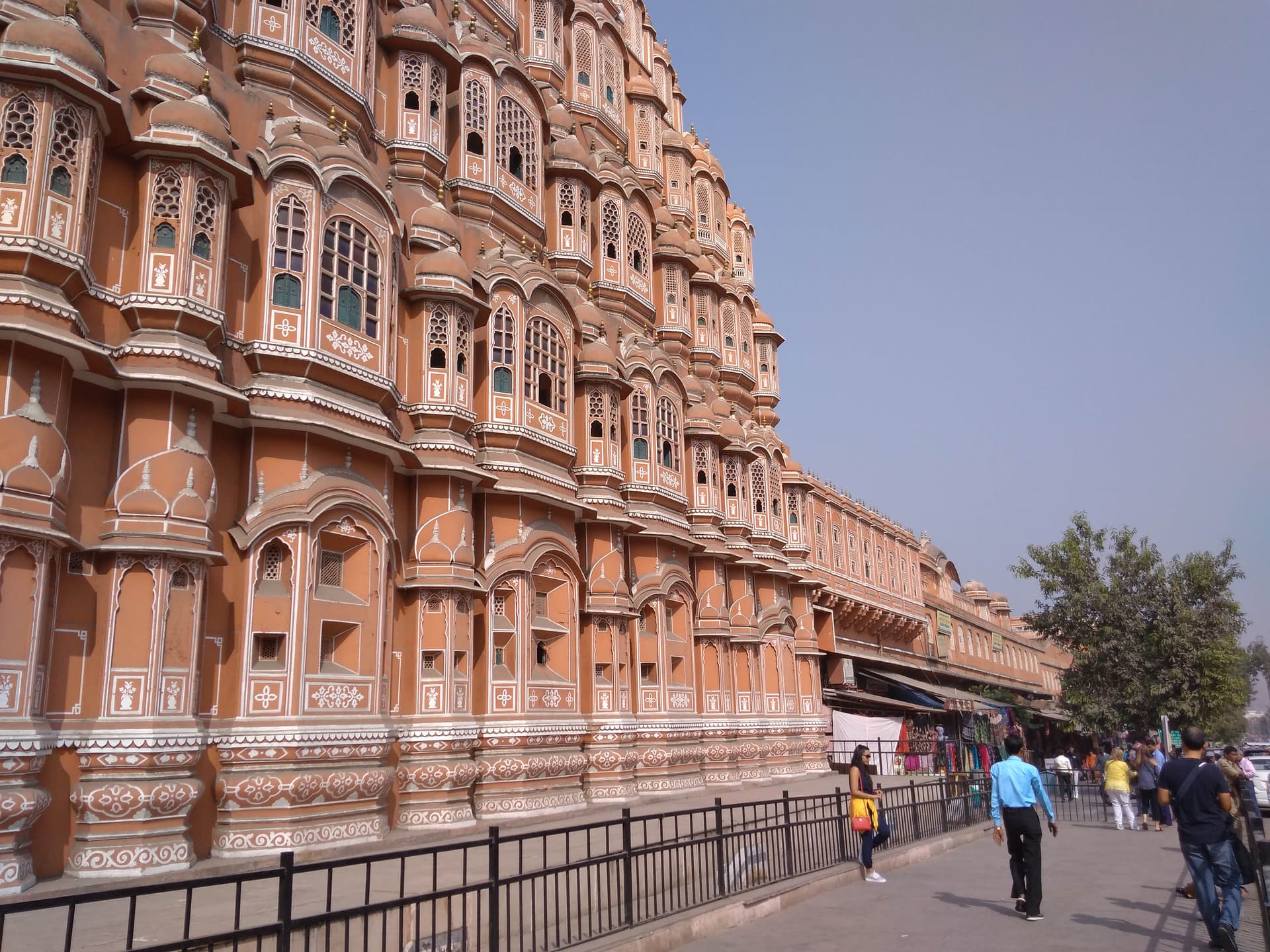
Jaipur's 1799 pink-sandstone honeycomb façade — five storeys of 953 jharokha windows that let royal women watch street life unseen.
Tentang
The Hawa Mahal, or "Palace of Winds," is one of the most recognizable architectural landmarks in India and a symbol of Jaipur's royal heritage. Built in 1799 by Maharaja Sawai Pratap Singh, this five-story structure was designed by renowned architect Lal Chand Ustad. Rising 146 feet above the bustling streets of Jaipur's old city, the Hawa Mahal comprises a stunning façade featuring 953 small, intricately carved sandstone windows—jharokhas—that are characteristic of Rajasthani architecture.
The building's distinctive honeycomb-like structure served a practical purpose during the Mughal era: it allowed the royal women of the zenana (women's quarters) to observe street life, festivals, and processions without being seen themselves, maintaining the tradition of purdah while allowing fresh air circulation—hence the poetic name "Palace of Winds." The latticed windows create a remarkable play of light and shadow throughout the day, with the pink-hued sandstone glowing warmly in morning sunlight and transforming into deep crimson tones at sunset. The geometric patterns and delicate carvings showcase exceptional Rajasthani craftsmanship.
For vegetarian visitors, the Hawa Mahal experience is entirely welcoming and hassle-free. The monument itself contains no food service, but surrounding Jaipur, particularly the adjacent bazaars, offers incredible vegetarian street food and restaurants. The interior of Hawa Mahal features multiple levels with connecting staircases, though photography inside can be challenging due to narrow corridors and limited natural light in some sections. The top floor provides panoramic views over the old city and its bustling markets.
Visiting Hawa Mahal is best experienced early in the morning (before 9 AM) when crowds are minimal and light conditions are optimal for photography. The building's complex geometry and intricate window designs offer endless compositional possibilities for photographers. Many visitors combine a Hawa Mahal visit with exploration of the adjacent City Palace, Jantar Mantar (an astronomical observation instrument), and the vibrant markets of Jaipur's old city.
The surrounding bazaars—particularly Johari Bazaar and Bapu Bazaar—are legendary for vegetarian street food: piping hot jalebis, flaky samosas, crispy kachoris, sweet lassi, and fresh fruit juices. The narrow lanes echo with vendors calling out their specialties, and the sensory experience of navigating these markets feels like stepping back into centuries past. Practical advice: visit in early morning or late evening to avoid intense heat and excessive crowds. Wear comfortable shoes suitable for climbing narrow staircases. The structure is best appreciated from outside for photography, though the interior climb offers useful context about the building's dimensions and layout.
Rencanakan Perjalanan
Jam Kunjungan
- • 9:00 AM to 5:00 PM (interior)
- • Last entry 4:30 PM
- • Façade is publicly visible 24 hours from Hawa Mahal Road
Biaya Masuk: Indian nationals ₹50, Foreigners ₹200. Children under 7 free. Composite ticket (₹200 Indian / ₹1,000 foreigner) covers Hawa Mahal + Amber Fort + Jantar Mantar + Albert Hall + Nahargarh — valid 2 days, excellent value if visiting all five.
Panduan Rute
🚇 Stasiun Terdekat: Badi Chaupar Metro Station (Pink Line) — 400 m walk to the façade across Hawa Mahal Road
🚶 Jalan dari Stasiun: From Badi Chaupar Metro exit, walk west on Hawa Mahal Road for 5 minutes (400 m). The façade appears suddenly on the right — the entry door is on the rear side via Tripolia Bazaar (a 5-minute walk around the building).
Parkir
street · ₹30–₹50 (paid street parking)
No dedicated parking — old-city lanes are too narrow. Limited paid street parking on Hawa Mahal Road, usually full by 10 AM. Strongly recommend metro, e-rickshaw, or Uber.
🚕 Tip Taksi: Uber and Ola drop on Hawa Mahal Road directly opposite the façade. E-rickshaw from Badi Chaupar Metro Station ₹20. Auto-rickshaw from Jaipur Junction Railway Station ₹100–₹150 (15 min); always insist on the meter or pre-fixed price.
Cara Menuju: Hawa Mahal is in the heart of Jaipur's old city, within walking distance of City Palace and Jantar Mantar. From Jaipur Railway Station (main station), take a prepaid taxi (₹150–250, 15 minutes) or auto-rickshaw (₹60–100, 20 minutes). Jaipur is well-connected by rail from Delhi (5 hours), and flights are available at Jaipur International Airport (25 km, 45 minutes by taxi).
Keluarga & Aksesibilitas
Keunggulan Keluarga
- • Top-floor views of the City Palace and Jantar Mantar are a hit with kids
- • Five storeys connected by ramps, not stairs — easier than expected for older children
- • No elevator and no ramp access from the street — strollers and wheelchairs cannot enter
- • Café terrace opposite (Wind View Café, Tattoo Café) lets parents rest while photographing the façade
Etika Budaya
Yang Harus
- Photograph the façade at sunrise (6:30 AM – 7:30 AM) from Wind View Café or Tattoo Café across the road — the pink glow is unmatched
- Buy the composite ticket (₹200) if you plan to visit Amber Fort and Jantar Mantar — saves significant money
- Enter through the rear (Tripolia Bazaar side) — many tourists miss this and stand confused on Hawa Mahal Road
- Combine with Johari Bazaar and Bapu Bazaar for street-food and gemstone shopping (5-minute walk)
- Hire an Archaeology Department-licensed guide (₹300 for 1 hour) — they know which jharokha was used by which queen
Yang Dilarang
- Do not climb on the jharokha (window) sills — the sandstone is fragile and security will fine you
- Do not buy "ruby" or "emerald" gemstones from touts inside or just outside — Jaipur's gem scams are India-famous
- Do not engage with auto drivers offering "free" tour packages — they take you to commission shops
- Do not visit at midday in summer — the open terraces hit 50°C and there is zero shade
- Do not photograph local women without permission, especially in adjacent Tripolia Bazaar
👕 Aturan Pakaian: Modest dress recommended (shoulders and knees covered). Comfortable walking shoes essential — interior ramps are smooth but the surrounding bazaar lanes are uneven.
📷 Aturan Foto: Personal photography is free and unrestricted both inside and outside. Tripods, gimbals, and professional shoots require ₹2,000/day permission from the Department of Archaeology and Museums, Rajasthan. Drones are prohibited (the area is a heritage zone with restricted airspace).
Waspada Penipuan
The Jaipur Gemstone Scam
A "friendly" local in or near Hawa Mahal befriends you and invites you to "his uncle's factory" to buy "investment-grade" gemstones to "resell back home for huge profit." The stones are worthless or grossly overvalued; the "buyback contact" never responds.
Saran Resmi: Buy gemstones only from BIS-hallmarked, government-recognised shops on MI Road or in Johari Bazaar with printed receipts. Never accept invitations to private "factories." This is one of India's most reported tourist scams.
The "Closed for Renovation" Diversion
Auto and tuk-tuk drivers near Jaipur Junction claim Hawa Mahal is "closed today" or "under renovation" and offer to take you to a "better" handicraft emporium where they earn 30–40% commission.
Saran Resmi: Hawa Mahal is open daily 9 AM–5 PM with no closures. Verify on the Rajasthan Tourism site, insist on Badi Chaupar, and use Uber/Ola if the driver refuses.
The Fake "Government Guide" at the Entrance
A man in a vaguely official kurta approaches at the rear entrance, claims to be a "government guide," quotes ₹300, then demands ₹1,500+ at the end with hard-sell tactics.
Saran Resmi: Real Department of Archaeology guides wear a photo ID card. Always agree on price in writing before starting and pay only after the tour ends.
Jejak Kuliner
Laxmi Misthan Bhandar (LMB)
0.3 kmPyaaz kachori, mawa kachori, and rabri — Jaipur's most famous pure-veg sweet shop since 1727 (yes, 1727)
Rawat Misthan Bhandar
1.2 kmThe original pyaaz kachori — locals argue this is better than LMB. Near Jaipur Railway Station; an old-city institution
Tattoo Café & Lounge
0.05 kmVeg pizza and fresh lime soda on the rooftop — directly opposite the Hawa Mahal façade for the best sunrise photo angle
Wind View Café
0.05 kmMasala chai and aloo paratha — the rooftop is the most-photographed Hawa Mahal viewpoint on Instagram
Sambhar Feast (MI Road)
1.5 kmAuthentic South Indian dosa and uttapam — pure-veg favourite of the South Indian community in Jaipur
Tempat Wisata Terdekat
City Palace
0.5 kmJaipur's royal residence — still the home of the former Maharaja's family, with public museums and stunning Mubarak Mahal courtyards.
Jantar Mantar
0.4 km18th-century UNESCO-listed astronomical observatory with 19 monumental masonry instruments — the world's largest stone sundial is here.
Johari Bazaar
0.4 kmJaipur's 250-year-old gem and jewellery market — the global capital of coloured-stone trading. Great for browsing; risky for buying without expertise.
Amber Fort
11 kmThe 16th-century hilltop palace-fort 11 km north — Jaipur's most spectacular monument, ideal for a half-day combo.
Nahargarh Fort
6 kmThe "Tiger Fort" perched on the Aravalli ridge — sunset views over the entire pink-city are legendary.
Toilet & Kebersihan
Tip Pro: Interior washrooms are 🔴 basic and Indian-style only. For premium-clean, use the washrooms at LMB restaurant (300 m, customers only) or Wind View Café across the road.
Pembayaran & Sinyal
🏧 ATM Terdekat: SBI ATM at Badi Chaupar (300 m); HDFC and ICICI ATMs on MI Road (1 km).
📡 Wi-Fi Publik: No public Wi-Fi inside the monument. Jio, Airtel, and Vi all have full bars in the old city.
🔌 Titik Pengisian: No public charging points inside. Cafés across the road (Wind View, Tattoo) have plug points for customers.
Fotografi & Drone
💰 Biaya Peralatan: Free for personal phones and handheld cameras. Tripods, gimbals, and professional shoots require ₹2,000/day permission from the Department of Archaeology and Museums, Rajasthan. Drones strictly prohibited.
📍 Spot Foto Terbaik: The rooftop of Wind View Café or Tattoo Café across Hawa Mahal Road at sunrise — the canonical Instagram angle showing all five storeys glowing pink. From inside, the top-floor jharokha view of the City Palace and old-city rooftops.
🌅 Cahaya Terbaik: 6:30 AM – 7:30 AM for the famous pink-glow façade; 5:00 PM – 6:00 PM for warm crimson tones at sunset
Belanja & Suvenir
✓ Yang Dibeli
- • Hand-block-printed Sanganeri textiles from Anokhi (MI Road)
- • Bandhani (tie-dye) sarees and dupattas from Bapu Bazaar
- • Blue pottery from authorised Rajasthan Government Emporium (RGEC) outlets
- • Lac bangles and meenakari jewellery — Maniharon Ka Rasta lane is the historic centre
✗ Yang Dihindari
- • Loose gemstones from anyone other than BIS-hallmarked shops with printed receipts (see scam alert)
- • "Antique" miniature paintings — almost all are mass-produced reproductions
- • "Pure pashmina" shawls hawked on the street — usually mixed-fibre acrylic
Tawar Menawar: Ya
Darurat & Kesehatan
Telepon Darurat
- Pan-India Emergency112
- Tourist Helpline (24×7, multilingual)1363
- Rajasthan Tourist Police+91-141-511-0598
- Women's Helpline (Rajasthan)1090
👮 Polisi Pariwisata: Tourist Police Booth at Badi Chaupar (300 m) — multilingual staff, 9 AM–9 PM
🎒 Barang Hilang: Report at the Tourist Police booth at Badi Chaupar. Lost passports also need a report at Kotwali Police Station, Chandpole Bazaar (1.5 km).
💊 Apotek Terdekat: Apollo Pharmacy on MI Road (1.2 km, open till 11:00 PM); 24×7 chemists at Soni Hospital (2 km).
Kualitas Udara: Jaipur AQI is "Moderate" most of the year, "Poor" in November–January due to winter inversion and crop-burning haze. Carry an N95 mask if asthmatic during winter months.
Keamanan Air: Drink only sealed bottled water. Tap water in the old city is not safe for tourists.
Tips Orang Lokal
🌅 Pemandangan Tersembunyi: Climb to the fifth-floor terrace ("Hawa Mandir") at opening — at 9:05 AM you can frame the Hawa Mahal's top minarets against the City Palace dome with no other tourists in your shot.
🎯 Hindari Keramaian: Tour buses arrive 11:00 AM – 4:00 PM. Visit at 9:00 AM opening or 4:30 PM (last 30 minutes) for a near-empty interior.
💎 Fakta Menarik: Hawa Mahal has no formal "front entrance" from Hawa Mahal Road — the famous pink façade is actually the rear of the palace. The real entry is from Tripolia Bazaar through a modest gate, because the building was designed strictly for the women of the zenana to look out, not for visitors to look in.
⚡ Tur Singkat
30 minutes — photograph the façade from Wind View Café rooftop, then walk to Johari Bazaar.
🔭 Tur Mendalam
Half day — 7 AM Wind View rooftop sunrise, 8 AM breakfast at LMB, 9 AM Hawa Mahal interior, 11 AM Jantar Mantar, 12:30 PM City Palace, 2 PM lunch at Niros, then Johari Bazaar shopping.
Sejarah
Sejarah
Hawa Mahal was commissioned in 1799 by Maharaja Sawai Pratap Singh, the grandson of Jaipur's founder Maharaja Sawai Jai Singh II. Pratap Singh — a devoted follower of Lord Krishna — designed the palace in the form of Krishna's crown (mukut), a religious symbolism unique among Rajasthani palaces. The building was conceived not as a residence but as a screened extension of the City Palace zenana (women's quarters), so that the royal women, observing strict purdah, could watch street processions, festival parades, and everyday city life through the 953 latticed jharokha windows without being seen themselves. The honeycomb design also created a Venturi-effect cooling system: hot air drawn through the small openings was accelerated and chilled, giving the palace its name "Hawa Mahal" — "Palace of Winds." After Indian independence in 1947 the palace passed to the Government of Rajasthan and is today maintained by the State Department of Archaeology and Museums.
🏛️ Arsitek: Designed by Lal Chand Ustad in the Rajput-Mughal hybrid style. The five-storey structure rises 87 feet (26.5 m) on a high plinth, built entirely of pink and red sandstone quarried near Jaipur. The 953 jharokhas are arranged in a precise geometric pattern that creates the building's distinctive honeycomb façade — one of the most recognisable architectural compositions in India.
Makna
Hawa Mahal is the visual centrepiece of the UNESCO-listed walled city of Jaipur (inscribed 2019) and the most-photographed monument in Rajasthan. Beyond its architectural pre-eminence as a fusion of Rajput and Mughal idioms, the building is a unique surviving example of zenana architecture engineered specifically to allow royal women to participate visually in public life without violating purdah. Its pink-sandstone façade is a defining symbol of Jaipur's identity as the "Pink City" — a colour scheme decreed in 1876 by Maharaja Sawai Ram Singh to welcome the visit of the Prince of Wales (later King Edward VII) and now enforced by municipal law across the entire walled-city precinct.
Kategori
Tag