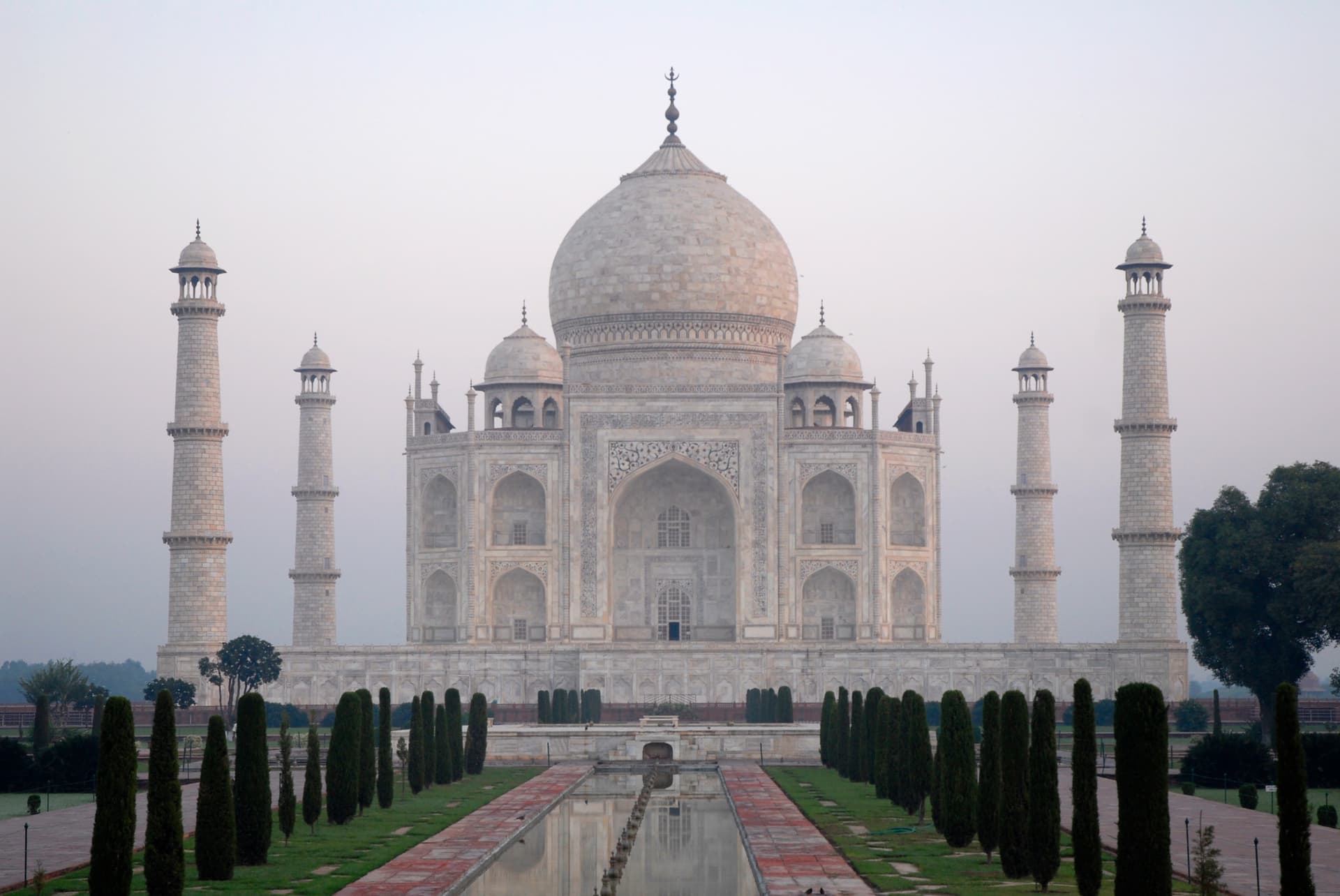
Taj Mahal
Auch Bekannt Als: The Crown of Palaces · ताज महल
Agra, Uttar Pradesh · monument
The world's most photographed marble mausoleum — Shah Jahan's 17th-century love letter to Mumtaz Mahal, glowing rose at dawn and amber at dusk.
Featured Outlets
The Local Flavor Pillar
Panchi Petha
Heritage InstitutionSince 1955 — Agra's most trusted petha institution
Agra's most trusted petha institution since 1955 — the definitive source for original, kesar, anguri, and pan petha varieties.
Original Plain Petha · ₹100
Avg. for two: ₹300 · ★★★★★
Deviram Sweets
Casual DiningLocals' Choice — Agra's definitive bedai breakfast
Agra's definitive address for bedai and jalebi — the classic city breakfast that locals have eaten for generations before monument visits.
Bedai with Aloo Sabzi · ₹45
Avg. for two: ₹150 · ★★★★
Pinch of Spice
Casual DiningTravellers' Choice — Agra's best value Mughlai veg thali
Agra's most reliable sit-down address for Mughlai vegetarian thali — paneer, dal makhani, saffron pulao, and tandoori bread in copper katoris.
Mughlai Veg Thali · ₹390
Avg. for two: ₹700 · ★★★★★
Sheroes Hangout
Casual DiningSocial Enterprise Café — Chhanv Foundation
A heartwarming social enterprise café near Taj South Gate, run by acid attack survivors — pay-what-you-can model.
Masala Chai · ₹30
Avg. for two: ₹150 · ★★★★
Esphahan (Oberoi Amarvilas)
Fine DiningOberoi Amarvilas — Asia's Top 3 Hotel Restaurant
Agra's most romantic fine-dining room — live sitar, direct Taj Mahal views, and an extensive Mughlai vegetarian menu at Oberoi Amarvilas.
Paneer Shahi Korma · ₹1800
Avg. for two: ₹8,000 · ★★★★★
Über diesen Ort
The Taj Mahal stands as one of the most magnificent architectural achievements in human history and a testament to eternal love. Built between 1632 and 1653 by the Mughal Emperor Shah Jahan in memory of his beloved wife Mumtaz Mahal, this ivory-white marble mausoleum has captivated millions of visitors across centuries. Located on the right bank of the Yamuna River in Agra, Uttar Pradesh, the monument represents the pinnacle of Indo-Islamic architecture, blending Persian, Islamic, and Indian design elements into a harmonious masterpiece.
The Taj Mahal complex spans 42 acres and features not just the main mausoleum but also a pristine garden, reflecting pools, a mosque, a guest house, and intricate fortified walls. The main dome, standing 73 meters high, crowns the white marble structure, while four slender minarets frame its corners with elegant precision. The entire exterior is inlaid with semi-precious stones—lapis lazuli, jade, crystal, turquoise, and mother of pearl—arranged in intricate floral patterns that seem to glow differently depending on the time of day and light conditions.
For vegetarian travellers, visiting the Taj Mahal is entirely comfortable. The monument itself offers no food, but the surrounding Agra has abundant vegetarian dining options. The marble work and geometric patterns feature no animal representations, adhering to Islamic design principles, making this a spiritually welcoming site for visitors of all faiths. The gardens surrounding the monument feature walking paths lined with cypress trees, flowering shrubs, and serene water channels that create peaceful spaces for reflection.
The best experience of the Taj Mahal involves multiple visits at different times of day. Sunrise visits offer a soft, golden glow with fewer crowds and cooler temperatures—ideal for photography and peaceful contemplation. Sunset brings dramatic orange and pink hues that transform the white marble into shades of amber and rose. Night viewing (available on full moon nights) reveals a ethereal, otherworldly beauty as the marble glows under moonlight.
Practical details: the site covers significant distance, and comfortable walking shoes are essential. The main platform requires removing footwear or wearing provided shoe covers, so slip-on shoes are recommended. Photography is allowed everywhere except inside the mausoleum chamber. Guides are available at the entrance and offer valuable historical context, though independent exploration with a good guidebook works equally well. The complexity of the marble inlay work rewards close observation—bring binoculars or zoom lens to appreciate the intricate craftsmanship up close.
Planen Sie Ihre Reise
Besuchszeiten
- • Sunrise to sunset (gates open ~30 min before sunrise, close ~30 min after sunset)
- • Mausoleum interior closes at sunset sharp
- • Night viewing on 5 nights around full moon (book separately at ASI office, Mall Road)
Eintrittsgebühr: Foreigners ₹1,100 + ₹200 mausoleum chamber fee. Indian nationals ₹50 (includes mausoleum). Children under 15 free. Tickets online at asi.payumoney.com — skip the counter queue.
Routenführer
🚇 Nächste U-Bahn: Taj East Gate Metro Station (Agra Metro Yellow Line) — opened 2024, 800 m walk to East Gate
🚶 Fußweg vom Metro: From Taj East Gate Metro Station, walk west along the marked pedestrian path for 800 m. The route is flat, paved, and signposted in English and Hindi.
Parken
nearby · ₹50–₹100 (paid)
Private vehicles must park 500 m away at Shilpgram (East Gate) or Saheli Park (West Gate); only electric shuttles and battery rickshaws (₹20/person) approach the gates due to pollution control rules.
🚕 Taxi-Tipp: Uber and Ola work to within 500 m of the gates. The driver will drop you at Shilpgram parking — take the free electric shuttle from there. Designated pickup is at Shilpgram, not the gate itself.
Anreise: Taj Mahal is 4 km south of Agra city center. From Agra Cantonment Railway Station (main station), take a prepaid taxi (₹200–300, 15 minutes) or auto-rickshaw (₹100–150, 20 minutes). From Agra Fort, it's a 2 km drive. Agra is well-connected by rail (trains from Delhi, Varanasi, Jaipur) and air (Agra Airport, though most fly into Delhi and travel by train or road).
Familie & Barrierefreiheit
Familien-Highlights
- • Free wheelchairs available at all three gates (deposit ID)
- • Vast Charbagh gardens are open and safe for children to walk
- • Audio guide for kids in English and Hindi (₹118)
- • Indian washrooms at the entrance complex; cleaner ones at Shilpgram
Kulturelle Regeln
Empfohlen
- Arrive 30 minutes before sunrise to enter the gates as they open — the marble glows pink in the first light
- Carry a valid photo ID — physical copy preferred; some queues reject digital-only IDs
- Wear shoe covers (free with ticket) or remove shoes before stepping onto the marble plinth
- Carry a refillable water bottle — refill stations are inside the complex
- Book online at asi.payumoney.com to skip the 30–60 minute counter queue
Vermeiden
- Do not bring food, sweets, gutka, tripods, or large bags — they will be confiscated at security
- Do not bring drones, charging banks above 10000 mAh, or external SLR lenses without registering them
- Do not touch the marble inlay or attempt to take "rubbings" — fines and prosecution are enforced
- Do not engage with unauthorised "guides" outside the gates — only ASI-licensed guides with photo IDs are legitimate
- Do not photograph inside the mausoleum chamber — strictly prohibited and actively enforced
👕 Kleiderordnung: Modest clothing recommended — shoulders and knees covered. No formal dress code, but the site is treated as a place of remembrance.
📷 Foto-Regeln: Personal phones and DSLRs are free to use in gardens and on the plinth. Tripods, gimbals, and professional shoots require a ₹2,500/day permit from the ASI office. Photography is strictly prohibited inside the mausoleum chamber.
Betrugswarnung
The "Free Photographer" Setup
A friendly local offers to take your family photo "for free" with your phone, then demands ₹500–₹2,000 once the photo is taken — refusing to return the phone until paid.
Offizieller Rat: Never hand your phone to anyone outside the official ticket counter. Use the timer or ask a fellow tourist (other foreigners are safest).
The "Closed Today" Auto Diversion
Auto-rickshaw drivers near Agra Cantt Station claim the Taj is "closed today" and offer to take you to a "better" emporium, marble factory, or shop where they earn commission.
Offizieller Rat: The Taj is closed only on Fridays — verify on tajmahal.gov.in. Insist on going to Shilpgram parking; if the driver refuses, walk away and book Uber/Ola.
The Fake "Skip-the-Line" Tickets
Touts outside the gates sell "VIP" or "skip-the-line" tickets at 3–5× the official price. The tickets are valid but provide no real fast-track access.
Offizieller Rat: Only buy at the ASI counter or asi.payumoney.com — the online ticket includes a separate ASI lane that genuinely is faster.
Genussroute
Joney's Place
0.4 km entferntBanana lassi and aloo paratha — vegetarian backpacker institution since 1978
Shankara Vegis Restaurant
0.3 km entferntPure-veg thali with Jain options (no onion, no garlic) — closest reliable veg restaurant to the South Gate
Saniya Palace Hotel rooftop
0.5 km entferntVeg biryani with a direct rear view of the Taj dome — sunset slot books out daily
Panchi Petha (Sadar Bazaar)
4 km entferntPetha (translucent ash-gourd sweet) and dalmoth — Agra's 150-year-old sweet shop
Sheroes Hangout (Fatehabad Road)
2.5 km entferntVeg lasagna and chai — café run by acid-attack survivors; pay-what-you-want
Sehenswürdigkeiten in der Nähe
Agra Fort
2.5 km entferntThe mighty red sandstone Mughal fort where Shah Jahan was imprisoned by Aurangzeb and gazed at the Taj from Musamman Burj.
Mehtab Bagh
2 km entferntThe "Moonlight Garden" across the Yamuna — the canonical sunset view of the Taj from the rear.
Itmad-ud-Daulah ("Baby Taj")
5 km entferntThe 1628 marble jewel-box tomb that was the architectural rehearsal for the Taj Mahal itself.
Fatehpur Sikri
39 km entferntAkbar's deserted red-sandstone capital city — a 90-minute drive west, ideal as a half-day combo.
Toiletten & Hygiene
Profi-Tipp: East Gate facilities are 🟢 cleanest and least crowded. West Gate washrooms are 🟡 average. Avoid the South Gate facilities — 🔴 basic. For premium-clean, walk to Sheroes Hangout café (2.5 km) or the Oberoi Amarvilas hotel lobby.
Zahlung & Konnektivität
🏧 Nächster Geldautomat: SBI ATM at the East Gate complex (next to ticket counter); HDFC and ICICI ATMs at Taj Ganj (700 m).
📡 Öffentliches WLAN: No reliable public Wi-Fi inside the complex. Carry mobile data — Jio and Airtel both have full bars.
🔌 Ladestationen: No public charging points. Bring a fully-charged power bank (under 10000 mAh; larger banks are confiscated at security).
Fotografie & Drohne
💰 Ausrüstungsgebühr: Free for personal phones and handheld cameras. Tripods, gimbals, and professional shoots require a ₹2,500/day ASI permit. External SLR lenses must be declared at security.
📍 Bester Fotoplatz: The "Diana Bench" at the start of the central reflecting pool — the iconic axial portrait. For a less-crowded angle, walk to Mehtab Bagh across the river for the rear sunset view.
🌅 Beste Lichtzeit: 6:00 AM – 7:30 AM in winter (pink light, low crowds); 5:30 PM – 6:30 PM in summer for amber tones
Einkaufen & Souvenirs
✓ Was Kaufen
- • Marble inlay (pietra dura) coasters and small boxes from government-certified workshops in Tajganj
- • Leather goods (Agra is the leather capital of North India) — buy from Sadar Bazaar, not gate-side touts
- • Sealed boxes of Panchi Petha (the original founder's shop is in Sadar Bazaar)
✗ Was Vermeiden
- • Marble "elephants" and miniature Taj Mahals from gate-side vendors — almost always plaster, not marble
- • Fake "antique" Mughal coins and miniature paintings — none are genuine
- • Pashmina shawls hawked outside the gates — usually mass-produced acrylic
Feilschen: Ja
Notfall & Gesundheit
Notrufnummern
- Pan-India Emergency112
- Tourist Helpline (24×7, multilingual)1363
- Agra Tourist Police+91-562-242-1204
- Women's Helpline1091
👮 Touristen-Polizei: Tourist Police booth at all three gates (East, West, South) — multilingual staff, 24×7
🎒 Fundbüro: Report lost items at the Tourist Police booth at the gate of entry. Lost passports must additionally be reported at Agra City Police Station, MG Road (4 km).
💊 Nächste Apotheke: Apollo Pharmacy on Fatehabad Road (1.8 km, open till 11:00 PM); 24×7 chemists at SR Hospital (2.5 km).
Luftqualität: Agra's AQI is "Poor to Very Poor" from late October to early February. Travellers with asthma should carry an N95 mask between November and January. The Taj itself is in a low-emission zone (vehicles banned within 500 m).
Wassersicherheit: Drink only sealed bottled water. Free filtered refill stations are available inside the complex near the mosque on the western side.
Insider-Tipps
🌅 Geheimer Aussichtspunkt: For the perfect "Taj at sunset" shot without crowds, cross the Yamuna to Mehtab Bagh (2 km, ₹25 entry) — the canonical rear view used in every postcard.
🎯 Trick gegen Menschenmassen: Friday is closed, so Saturday is the worst day — domestic tourists pile in. Visit on a Tuesday or Wednesday at sunrise for the lowest crowds and best light.
💎 Wissenswertes: The four minarets are tilted slightly outward — by 1.5° each — so that in case of an earthquake they would fall away from the central mausoleum and not damage it. A 17th-century engineering masterstroke.
⚡ Schnellbesuch
90 minutes — enter at East Gate, walk the central axis to the mausoleum, photograph the inlay close-up, exit. Skip the museum.
🔭 Ausführliche Tour
Full day — Sunrise at the Taj, breakfast at Joney's Place, Agra Fort 10 AM–12 PM, lunch at Pinch of Spice, Itmad-ud-Daulah at 3 PM, sunset at Mehtab Bagh.
Chronik
Geschichte
Construction of the Taj Mahal began in 1632, one year after the death of Mumtaz Mahal in childbirth, and was substantially completed in 1648. The mausoleum and its surrounding complex — gardens, mosque, guesthouse, and outer gateway — took an additional five years and 22,000 craftsmen, masons, and artisans to finish. Materials were sourced across an empire: white marble from Makrana in Rajasthan, red sandstone from Fatehpur Sikri, jade and crystal from China, lapis lazuli from Afghanistan, sapphire from Sri Lanka, and turquoise from Tibet. After Shah Jahan was deposed by his son Aurangzeb in 1658 and imprisoned in Agra Fort, he reportedly spent his final eight years gazing at the Taj from the Musamman Burj balcony, and was eventually buried beside Mumtaz in the only asymmetrical element of the otherwise perfectly mirrored complex.
🏛️ Architekt: Ustad Ahmad Lahauri is credited as the chief architect, supervising a team that included calligrapher Amanat Khan, dome specialist Ismail Afandi (from the Ottoman court), and master inlay-craftsmen from Persia. The design synthesises Persian, Ottoman Turkish, Indian, and earlier Mughal architectural traditions.
Bedeutung
Designated a UNESCO World Heritage Site in 1983, the Taj Mahal is widely regarded as the finest example of Mughal architecture and one of the greatest achievements of Indo-Islamic art. It receives 6–8 million visitors annually, making it one of the most-visited monuments in the world. Beyond its architectural pre-eminence, the Taj remains a powerful cultural symbol of India globally and the canonical reference for marble inlay (pietra dura) work, which continues as a living craft in Agra to this day.
Kategorien
Schlagwörter